Thursday, April 12, 2018

Oracle’s Revolutionary New Database Automates Key Functions for Enterprise Customers


Oracle recently announced that Oracle Autonomous Data Warehouse Cloud, the first service based on the revolutionary new Oracle Autonomous Database, is available worldwide. At an event at Oracle headquarters, a group of customers and partners who were given exclusive access to test-drive the new self-driving database spoke about the value of autonomous capabilities. Accenture, Hertz, QMP Health, and Qualex joined Oracle executives on-stage to share the breakthrough results they are already experiencing with Oracle Autonomous Data Warehouse Cloud, including performance advantages, lower costs, and improved security posture of their data and systems.

“Oracle Autonomous Database is a truly transformative technology for our 420,000 global customers and an important breakthrough for the industry,” said Andy Mendelsohn, executive vice president, Database Server Technologies, Oracle. “The self-driving, self-securing and self-repairing capabilities revolutionize how our customers will manage and secure their data. Nothing else like this exists in the market today.”
The first of its kind, Oracle Autonomous Database introduces self-driving, self-securing, and self-repairing capabilities that automate key management and security processes in database systems like patching, tuning and upgrading, all while keeping the critical infrastructure constantly running. With the Oracle Autonomous Database, Oracle can help customers minimize risk and improve the security capabilities of their data and systems. Oracle Autonomous Data Warehouse Cloud is the first of many Oracle Autonomous Database Cloud services that uses machine learning to deliver outstanding performance, simplicity and elasticity for data warehouses.

Organizations Test Drive Autonomous Database
 “We are at the dawn of the intelligent enterprise era, and having an automated database is a natural progression,” said Paul Daugherty, chief technology and innovation officer, Accenture. “Being able to build a self-driving data warehouse – in some cases, in only a matter of minutes or hours – can dramatically simplify the ability to generate powerful business insights, much faster than previously possible.”

“The flexibility of Autonomous Data Warehouse Cloud in terms of delivering instantaneous, fully elastic scalability is truly outstanding and unique in the market,” said Erik Dvergnes, Architect, Aker BP.

“Our initial tests have shown that Oracle Autonomous Data Warehouse Cloud offers important innovations,” said Manuel Martin Marquez, Big Data Engineer and Data Scientist, CERN.  “For instance, Oracle Autonomous Data Warehouse Cloud automatically reduced the storage required by important control systems by a factor of ten.”

Jerry Gearding, CTO, DX Marketing said, “The elastic scalability of the Autonomous Data Warehouse Cloud, where we can easily scale up and down and only pay for processor services when we're actually using them is a big benefit for DX Marketing.”

“I've been really impressed with how Oracle Autonomous Data Warehouse Cloud can take different types and sizes of analytic workloads and get better performance without any fine-tuning,” said Benjamin Arnulf, Director of Business Intelligence and Analytics, Hertz. “It will allow us to reduce costs and re-invest savings into improving customer service, thus rewarding our customers.”

Looker, a cloud-based BI and analytics company, sees a growing need for enterprise-ready but easy-to-use data warehousing. According to Keenan Rice, Vice President of Strategic Alliances, Looker, “We're seeing a lot of demand from customers for a fully managed experience, and the Autonomous Data Warehouse Cloud makes it a lot easier for Looker's customers to derive value from their data.”

“We've found that the Autonomous Data Warehouse Cloud is very easy to use, very easy to load data, and the performance has been amazing,” said Miles Oustad, Data Integration Team Manager, Minnesota State.

“When you're dealing with human lives, time is everything,” said Michael Morales, CEO, QMP Health. “Having the Autonomous Data Warehouse Cloud automatically tune and manage itself with no downtime means faster response times and quicker decisions - that's critical for us and our patients.”

“Oracle Autonomous Data Warehouse Cloud is the perfect solution for 11880.com Solutions AG,” said Christian Maar, CEO, 11880.com.  “It requires no administration resources, it delivers great performance, and its flexibility means it can scale as our company grows.”

Industry Analysts Validate Market Leadership
Multiple independent industry analyst reports recently recognized Oracle for its Autonomous Database technology.  Following are some of these reports and key findings:

·         Gartner again positioned Oracle highest in “ability to execute” in its *Gartner, “Magic Quadrant for Data Management Solutions for Analytics” by Adam M. Ronthal, Roxane Edjlali, Rick Greenwald, 13 February 2018 report
·         In the February 2018 IDC Perspective Oracle’s Autonomous Database: AI-Based Automation for Database Management and Operations, authors Carl W. Olofson and David Schubmehl wrote, “Oracle is at the vanguard of a movement to make enterprise software easier to deploy, use and administer, using artificial intelligence and machine learning to provide capabilities requiring little or no human intervention to manage software.”
·         KuppingerCole’s Executive View: Oracle Autonomous Database January 2018 report said, “Oracle goes much further than just automation with its newest offering.   This approach has immense potential benefits not just for reducing labor and costs for customers, but for dramatically improving database’s resiliency against both human errors and malicious activities, internal or external.  Each database is also designed to have security features enabled by default and relevant parameters automatically configured according to current security best practices.”
  

*Gartner, “Magic Quadrant for Data Management Solutions for Analytics” Adam M. Ronthal, Roxane Edjlali, Rick Greenwald, 13 February 2018.

Gartner does not endorse any vendor, product or service depicted in its research publications, and does not advise technology users to select only those vendors with the highest ratings or other designation. Gartner research publications consist of the opinions of Gartner's research organization and should not be construed as statements of fact. Gartner disclaims all warranties, expressed or implied, with respect to this research, including any warranties of merchantability or fitness for a particular purpose.

About Oracle
The Oracle Cloud offers complete SaaS application suites for ERP, HCM and CX, plus best-in-class database Platform as a Service (PaaS) and Infrastructure as a Service (IaaS) from data centers throughout the Americas, Europe and Asia. For more information about Oracle (NYSE:ORCL), please visit us at oracle.com.

Trademarks

Oracle and Java are registered trademarks of Oracle and/or its affiliates. Other names may be trademarks of their respective owners.


Wednesday, April 11, 2018

IDC Philippines Opens Nominations for the 2nd IDC Digital Transformation Awards


IDC Philippines announced today that it has opened nominations for IDC’s Digital Transformation Awards (IDC DXa), to recognize the best digital transformation (DX) initiatives in the country. Running on its second year, IDC DXa honors the achievements of organizations that have successfully planned and executed the digital transformation of one or multiple areas of their business through the application of digital and disruptive technologies. "After the success of our inaugural run last year, we identified a number of game-changing DX projects that were institutionalized by various future-proof companies from the banking, BPO, utilities, and logistics industries, among others,” said Sudev Bangah, Managing Director, IDC ASEAN. “This shows that Philippine organizations are more than ready to lead in the DX economy. The fast-moving pace and momentum of DX in the country should be an inspiration for more organizations, and we expect more innovative projects competing at the upcoming awards this year." IDC’s DX Awards recognizes and celebrates the organizations leading DX in the Asia/Pacific region. These leaders have demonstrated their ability to collaborate within their respective organizations and ecosystems, to develop innovative solutions that will help them accelerate growth in the DX economy. Onalytica, an influencer relationship management software company, recently named IDC as the number 1 global thought leader in DX. This recognition solidifies IDC's prime position in advocating DX to help organizations understand the use of technologies and create a competitive advantage through new offerings, business models, and relationships. "We see more Filipino companies scaling up their DX journey to a macroeconomic scale, as their ability to offer digitally transformed offerings and experiences becomes an important measure of competitiveness and success in the market," said Jubert Alberto, IDC Philippines, Operations Head. "This ties in with our recent prediction that local enterprises are heading to a higher level of DX adoption maturity in the next 12 to 36 months. In the same manner, as the government beefs up its ICT initiatives, a clearer digital vision for the country should be seen.” IDC Philippines will select winners from seven categories in the awards, namely Digital Transformer of the Year; Digital Disruptor of the Year; DX Information Visionary, DX OmniExperience Innovator, DX Talent Accelerator, DX Leader (previously L3D Mastery); and DX Operating Model Master (previously Operational Transformation). All winners from the Philippines automatically qualify for accolades at the regional level, alongside the highest distinction for Asia/Pacific which is Digital Trailblazer of the Year. Entries received locally will be judged by an exclusive panel of IDC Philippines analysts and industry thought leaders. Nominations are open beginning today until June 30th. Philippine winners of IDC DX Awards will be announced at the local Digital Transformation Summit in September. The Philippine DX Awards winners will join other country winners across Asia/Pacific at the culminating event in Singapore on 25 October 2018, where they will go head to head to determine the region’s best. Last year, three local winners (i.e., Maynilad, AIR21, and BIMA) represented the country in the IDC DXa regional finals in Singapore. To nominate a project or a DX executive, visit our nomination site: https://www.idcdxawards.com/nomination/ For more information on the awards and judging criteria, please visit the IDC DX Awards website: http://idcdxawards.com For queries about IDC Digital Transformation Awards, contact Celeste Narvaez at cnarvaez@idc.com or Alon Rejano at arejano@idc.com. For media inquiries, contact Glorie Perez at gprez@idc.com.


Friday, April 6, 2018

IDC Philippines: Changing Device Usage Habits of Filipinos will Fuel Growth of Smartphones and PCs in 2018

According to the International Data Corporation (IDC), device usage habits of Filipinos are rapidly changing, and it is reshaping the connected device trends in the country. Based on IDC's latest Asia/Pacific Quarterly Mobile Phone Tracker and Asia/Pacific Quarterly Personal Computing Device Tracker, smartphone shipments declined 7% to approximately 15 million units in 2017, while tablet shipments posted a 30% year-over-year (YoY) drop to 1 million units. On the other hand, PC shipments in 2017 amounted to around 2 million units, showing flat growth of 1% YoY.
Smartphone shipments recorded its first decline since its introduction into the local market as intense competition from top brands, such as Samsung, OPPO, and vivo, resulted in some vendors being ousted from the market. Tablets continued to decline as their significance in the market waned due to the lack of practical use cases and cannibalization by smartphones with larger screen sizes. Traditional PCs continued to grow due to increased education-related purchases and the growing traction of eSports in the country, among others.
Smartphones and Tablets – Changes in Filipinos’ Usage Requirements
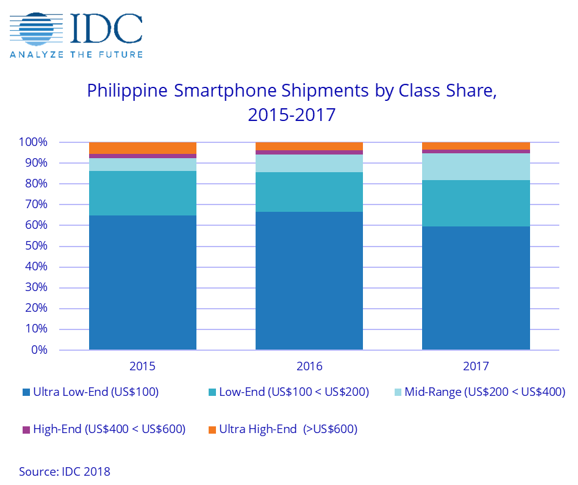
A clear trend has recently emerged in the Philippine smartphone market where end users are shifting to handsets with higher specs and better features. The Philippines has historically been among the price-sensitive markets in Asia/Pacific and still is. Despite this, the average selling price of smartphones in 2017 grew to US$134, a 13% YoY increase. Ultra low-end smartphones (<US$100) still hold the lion's share of the market, accounting for 59% of all smartphones in 2017 compared with 67% in 2016. Meanwhile the combined share of low-end (US$100<US$200) and midrange (US$200<US$400) smartphones grew to 35% from 28% in 2016.

Samsung and Chinese brands such as OPPO and Vivo were the key driving brands that led to the growth of the low-end and midrange segments in 2017. "Heavy marketing campaigns and lucrative sales promoter incentives enabled these brands to strengthen their mindshare in the local market, increase their shipments, and grow their respective market shares. The assault of these brands affected the sales of some of the players, resulting in them reducing their supplies, which ultimately impacted overall smartphone shipments," said Jensen Ooi, Senior Market Analyst, Client Devices, IDC ASEAN.
From a screen size perspective, phablets (5.5”<7”) recorded significant growth in recent years, accounting for about a quarter of smartphone shipments in 2017. "As mobile content continues to grow, smartphones have become the primary device for basic productivity and everyday media consumption, and this fuels the need for larger screens and higher specs," Ooi added. On the other hand, slate tablets (7”<11”), which used to be popular at one point, have begun to suffer from decreasing sales because they cannot offer the same level of practicality that phablets provide.
Aside from slate tablets, detachable tablets have also not caught on well in the Philippine market. Filipino end users find the relatively low specs but high price of detachables unappealing and opt for laptops within the same price range, which provide better overall utility.

PCs – Thriving in a Smartphone-Driven Country
The Philippines is among the few remaining bright spots for traditional PCs in Asia/Pacific. Looking closer, it is the only one in Southeast Asia that still shows PC adoption growth. Over the past five years, the Philippine PC market has been growing at a compound annual growth rate (CAGR) of 3%, while its ASEAN neighbors have been declining at CAGRs of around -3% to -12%. The Philippines’ growth trend has been driven primarily by the country's slow technology adoption, but in the past few years, the mobility trend and large millennial Filipino population are also propelling traditional PC adoption to even higher levels.
"Despite smartphones having drawn away a portion of consumer demand in recent years, desktop and notebook PCs remain viable personal computing devices, especially for heavy workloads and higher-level entertainment," said Sean Paul Agapito, Associate Market Analyst, Client Devices, IDC Philippines. While the growing on-the-go culture has fueled the PC-versus-smartphone trend among Filipino consumers, it has also influenced form factor trends within the PC domain. Laptops have already overtaken desktops as the traditional PC of choice among consumers, with the latter increasingly being relegated to commercial and gaming uses.


What to expect in 2018?
The smartphone market in the Philippines is expected to rebound in 2018 as competition between popular brands, which will continue to strengthen their positions, and local and minor brands, which will continue to struggle to stay relevant, intensifies. "We expect smartphone vendors to continue shipping in more phablets and equipping their new models with enticing features, such as dual cameras, thin bezels, and on-device artificial intelligence,” Ooi said.
Meanwhile, the Philippine PC market is expected to grow in the coming years to be driven by the hype and popularity of PC gaming and esports, growing momentum of telecommuting, and shift toward digital learning/education. "As the Philippine economy matures, Internet services and coverage improve, and more Filipinos realize the potential of the Internet beyond social interaction – such as for education, work, and business among others – demand for PCs in the country is expected to grow even further," Agapito said.
For more information about the research, please contact Jensen Ooi at jooi@idc.comand Sean Paul Agapito at sagapito@idc.com.  For media inquiries, please contact Jubert Alberto at jalberto@idc.com or Rushanthine at rvelayutham@idc.com
-Ends-
 
About IDC Trackers
IDC Tracker products provide accurate and timely market size, vendor share, and forecasts for hundreds of technology markets from more than 100 countries around the globe. Using proprietary tools and research processes, IDC's Trackers are updated on a semiannual, quarterly, and monthly basis. Tracker results are delivered to clients in user-friendly excel deliverables and on-line query tools. The IDC Tracker Charts app allows users to view data charts from the most recent IDC Tracker products on their iPhone and iPad.

About IDC
International Data Corporation (IDC) is the premier global provider of market intelligence, advisory services, and events for the information technology, telecommunications, and consumer technology markets. With more than 1,100 analysts worldwide, IDC offers global, regional, and local expertise on technology and industry opportunities and trends in over 110 countries. IDC's analysis and insight helps IT professionals, business executives, and the investment community to make fact-based technology decisions and to achieve their key business objectives. Founded in 1964, IDC is a subsidiary of IDG, the world's leading technology media, research, and events company. To learn more about IDC, please visit www.idc.com. Follow IDC on Twitter at @IDC.
All product and company names may be trademarks or registered trademarks of their respective holders.

Wednesday, April 4, 2018

AMD Fuels Pro Video Powerhouse: Accelerated REDCODE RAW 8K Workflows for Adobe Premiere Pro CC with AMD Radeon Pro SSG Graphics


AMD (NASDAQ: AMD) and Adobe today announced a powerful new solution for demanding 4K and 8K video workflows that enables seamless editing of popular video formats, accelerating the production process while giving editors unprecedented control of their projects using high-resolution, uncompressed footage. Launching at the 2018 NAB Show next week, the new version of Adobe Premiere Pro CC includes native support for AMD Radeon Pro SSG graphics, the groundbreaking solution designed specifically for video production that combines the extraordinary performance and capabilities of AMD “Vega” GPU architecture with 2TB of NVMe storage integrated onto the graphics card. Together, Adobe Premiere Pro CC and Radeon Pro SSG represent the most compelling solution for high-resolution video production, supporting 4K and 8K footage in popular native camera formats, including ARRI AMIRA, Canon XF and RAW, Panasonic AVC and P2, REDCODE RAW, and Sony XDCAM, XAVC, and RAW. Working directly with these source formats typically requires extraordinary computational performance and memory capacity to decode them in real-time. The Adobe Premiere Pro CC and Radeon Pro SSG workflow reduces the CPU and memory bottlenecks traditionally encountered, allowing editors to do their best work with uncompressed visual fidelity.
“The promise of filming in 4K and 8K has always been about removing creative constraints, about providing more creative control with higher-resolution footage. Unfortunately, those creative ambitions have been sidelined by technology limitations that have made 4K and 8K editing practically impossible,” said Ogi Brkic, general manager, professional graphics, Radeon Technologies Group, AMD. “Today, reality catches up to ambition as Adobe Premiere Pro CC and Radeon Pro SSG deliver the high-resolution workflow you’ve always dreamed of, enabling accelerated editing of a wide range of media, letting creators bring their visions to life in uncompressed 8K glory.”
“Adobe Premiere Pro CC has always been the standard bearer for innovation in editing, introducing 4K, 8K and 360-video workflows to enable editors to expand their capabilities and explore their creativity. Today, through our collaboration with AMD, we’re taking high-resolution editing to a new level in Adobe Premiere Pro CC with support for Radeon Pro SSG,” said Sue Skidmore, head of partner relations for Video at Adobe. “Collectively, Adobe Premiere Pro CC and Radeon Pro SSG represents the ideal solution for 4K and 8K workflows, with software and hardware designed to allow your creativity to shine.”
Most productions today film in high resolution – 4K or 8K – to provide the greatest flexibility in post-production; however there has been no effective way to edit multiple streams of that footage at full resolution. Editors have been forced to do their work with proxy files rather than the original high-resolution footage, transcoding to lower resolutions that are more easily managed by most workstations. With the combination of Adobe Premiere Pro CC and Radeon Pro SSG, proxy files are a thing of the past. Editors can now work with multiple streams of 4K or 8K footage at full resolution in an uncompressed format as smoothly as they could with lower quality proxy files. The solution dramatically reduces CPU utilization and eliminates the burden on local memory, allowing edits to footage while preserving the base cache if anything needs to be reverted or changed, and serves as a persistent cache that can be moved from workstation to workstation as needed without having to reload footage.
Radeon Pro SSG
The Radeon Pro SSG represents a fundamental shift in the science of PC technology, incorporating high-speed, high-capacity NVMe devices onboard the graphics card. It is the first graphics card to offer 2TB of storage specifically for demanding workflows such as high-resolution video, VR, and 360 video stitching. The Radeon Pro SSG harnesses the “Vega” GPU architecture, delivering up to 12.3 TFLOPS of peak single precision compute performance for the most demanding workloads. The card also features 16GB of High-Bandwidth Cache based on the newest, ultra-fast HBM2 Error Correcting Code (ECC) Memory1, and harnesses the revolutionary High Bandwidth Cache Controller (HBCC), the world's most advanced GPU memory architecture.
Availability
Adobe Premiere Pro CC with native support for Radeon Pro SSG will be available April 3, and the Adobe Premiere Pro CC + Radeon Pro SSG workflow is expected to be supported on validated workstation platforms soon. Those attending the 2018 NAB Show can see the new workflow in action at AMD’s booth, #SL8224, South Hall in the Las Vegas Convention Center.

Supporting Resources
·         Read more about Radeon Pro graphics cards
·         Follow @RadeonPro on Twitter
·         Learn more about Adobe Premiere Pro CC here

Adobe at NAB 2018
Adobe will showcase powerful new updates to Adobe Creative Cloud, giving video pros the world’s best tools for video editing and motion graphics. The latest release brings amazing new features and faster workflows for color, graphics, audio, animation, collaboration and VR. Highlights include shot comparison, automatic color matching, and intelligent audio and easy rotate view controls for VR content in Adobe Premiere Pro CC; streamlined graphics workflows with master properties to rapidly edit layer properties across compositions in After Effects CC; added efficiency in Audition CC; integration with Adobe Stock for sourcing video footage and Motion Graphics templates; trigger improvements in Adobe Character Animator CC; and easily invite anyone with refined collaboration workflows in Team Projects. Adobe Creative Cloud offers an unparalleled creative ecosystem of interconnected apps and services. NAB attendees can see the latest product demos at the Adobe booth (#SL4610, South Hall in the Las Vegas Convention Center). For more information, visit www.adobe.com.

About AMD
For more than 45 years, AMD has driven innovation in high-performance computing, graphics, and visualization technologies ― the building blocks for gaming, immersive platforms, and the datacenter. Hundreds of millions of consumers, leading Fortune 500 businesses, and cutting-edge scientific research facilities around the world rely on AMD technology daily to improve how they live, work, and play. AMD employees around the world are focused on building great products that push the boundaries of what is possible. For more information about how AMD is enabling today and inspiring tomorrow, visit the AMD (NASDAQ: AMD) websiteblogFacebook and Twitter pages.

1. ECC support is limited to the HBM2 memory and ECC protection is not provided for internal GPU structures.

© Copyright 2018 Advanced Micro Devices, Inc. All rights reserved. AMD, the AMD Arrow logo, Radeon Pro Graphics, Radeon Pro SSG, and combinations thereof are trademarks of Advanced Micro Devices, Inc. Adobe and Premiere Pro CC are registered trademarks of Adobe Systems Inc. Other names are for informational purposes only and may be trademarks of their respective owners.

Cautionary Statement
This press release contains forward-looking statements concerning Advanced Micro Devices, Inc. (AMD) including the expected benefits, availability and timing of Adobe Premiere Pro CC with AMD Radeon™ Pro SSG graphics on validated workstation platforms, which are made pursuant to the Safe Harbor provisions of the Private Securities Litigation Reform Act of 1995. Forward-looking statements are commonly identified by words such as "would," "intends," "believes," "expects," "may," "will," "should," "seeks," "intends," "plans," "pro forma," "estimates," "anticipates," or the negative of these words and phrases, other variations of these words and phrases or comparable terminology. Investors are cautioned that the forward-looking statements in this document are based on current beliefs, assumptions and expectations, speak only as of the date of this document and involve risks and uncertainties that could cause actual results to differ materially from current expectations. Such statements are subject to certain known and unknown risks and uncertainties, many of which are difficult to predict and generally beyond AMD's control, that could cause actual results and other future events to differ materially from those expressed in, or implied or projected by, the forward-looking information and statements. Material factors that could cause actual results to differ materially from current expectations include, without limitation, the following: Intel Corporation’s dominance of the microprocessor market and its aggressive business practices may limit AMD’s ability to compete effectively; AMD has a wafer supply agreement with GF with obligations to purchase all of its microprocessor and APU product requirements, and a certain portion of its GPU product requirements, from GLOBALFOUNDRIES Inc. (GF) with limited exceptions. If GF is not able to satisfy AMD’s manufacturing requirements, its business could be adversely impacted; AMD relies on third parties to manufacture its products, and if they are unable to do so on a timely basis in sufficient quantities and using competitive technologies, AMD’s business could be materially adversely affected; failure to achieve expected manufacturing yields for AMD’s products could negatively impact its financial results; the success of AMD’s business is dependent upon its ability to introduce products on a timely basis with features and performance levels that provide value to its customers while supporting and coinciding with significant industry transitions; if AMD cannot generate sufficient revenue and operating cash flow or obtain external financing, it may face a cash shortfall and be unable to make all of its planned investments in research and development or other strategic investments; the loss of a significant customer may have a material adverse effect on AMD; AMD’s receipt of revenue from its semi-custom SoC products is dependent upon its technology being designed into third-party products and the success of those products; global economic uncertainty may adversely impact AMD’s business and operating results; the markets in which AMD’s products are sold are highly competitive; AMD may not be able to generate sufficient cash to service its debt obligations or meet its working capital requirements; AMD has a large amount of indebtedness which could adversely affect its financial position and prevent it from implementing its strategy or fulfilling its contractual obligations; the agreements governing AMD’s notes and the Secured Revolving Line of Credit impose restrictions on AMD that may adversely affect its ability to operate its business; the products that AMD sells are complex and may be subject to security vulnerabilities that could result in, among other things, the loss, corruption or misuse of confidential data by unauthorized third parties or system performance issues. AMD's efforts to prevent and address security vulnerabilities can be costly and may be partially effective or not successful at all; AMD's issuance to West Coast Hitech L.P. (WCH) of warrants to purchase 75 million shares of its common stock, if and when exercised, will dilute the ownership interests of its existing stockholders, and the conversion of the 2.125% Convertible Senior Notes due 2026 may dilute the ownership interest of its existing stockholders, or may otherwise depress the price of its common stock; uncertainties involving the ordering and shipment of AMD’s products could materially adversely affect it; the demand for AMD’s products depends in part on the market conditions in the industries into which they are sold. Fluctuations in demand for AMD’s products or a market decline in any of these industries could have a material adverse effect on its results of operations; AMD’s ability to design and introduce new products in a timely manner is dependent upon third-party intellectual property; AMD depends on third-party companies for the design, manufacture and supply of motherboards, software and other computer platform components to support its business; if AMD loses Microsoft Corporation’s support for its products or other software vendors do not design and develop software to run on AMD’s products, its ability to sell its products could be materially adversely affected; and AMD’s reliance on third-party distributors and AIB partners subjects it to certain risks.  Investors are urged to review in detail the risks and uncertainties in AMD's Securities and Exchange Commission filings, including but not limited to AMD's Annual Report on Form 10-K for the year ended December 30, 2017.

*This is Press Release

Monday, April 2, 2018

Oracle Redefines the Cloud Database Category with World’s First Autonomous Database


Oracle Executive Chairman and CTO Larry Ellison recently announced the availability of the first service based on the revolutionary new Oracle Autonomous Database. The world’s first self-managing, self-securing, self-repairing database cloud service, Oracle Autonomous Data Warehouse Cloud, uses machine learning to deliver industry-leading performance, security capabilities, and availability with no human intervention, at half the cost of Amazon Web Services. 

“This technology changes everything,” said Ellison. “The Oracle Autonomous Database is based on technology as revolutionary as the Internet. It patches, tunes, and updates itself. Amazon’s databases cost more and do less.”

Oracle Autonomous Data Warehouse Cloud delivers all of the analytical capabilities, security features, and high availability of the Oracle Database without any of the complexities of configuration, tuning, and administration -- even as warehousing workloads and data volumes change. The autonomous database is an entirely new class of offering which requires zero operational administration on the customer’s part, enabling cloud data warehousing that is:

·         Easy. The industry’s first one-step warehouse provisioning spins up a secure data warehouse with automatic backup, encryption, and a high availability architecture in mere seconds. Migration to cloud is simple due to full compatibility with existing on-premises databases.

·         Fast. Industry-leading query performance with no tuning required. Oracle Autonomous Data Warehouse Cloud is so fast that Oracle guarantees the same workload at half the cost of Amazon Web Services[i].

·         Elastic. Independent, online scaling of compute and storage. The ability to dynamically grow or shrink resources enables true pay-per-use, dramatically lowering costs.

The world’s most popular data warehouse database is now the world’s simplest and safest. Leveraging decades of experience and technology leadership to transform how companies benefit from database services, Oracle Autonomous Data Warehouse Cloud is the first of many Oracle Autonomous Database Cloud services. Other services in development include Oracle Autonomous Database for Transaction Processing, Oracle Autonomous NoSQL Database for fast, massive-scale reads and writes (commonly demanded by the Internet of Things), and Oracle Autonomous Graph Database for network analysis. Each of these offerings is tuned to its specific workload, and shares the defining characteristics of Oracle Autonomous Database services:

·         Self-managing. Eliminates human labor and human error to provision, secure, monitor, backup, recover, troubleshoot, and tune the database. Automatically upgrades and patches itself while running.

·         Self-securing. Protects from external attacks and malicious internal users. Automatically applies security updates while running to protect against cyberattacks, and automatically encrypts all data.
·         Self-repairing.  Provides automated protection from all planned and unplanned downtime with up to 99.995 percent availability, resulting in less than 2.5 minutes of downtime per month, including planned maintenance.

The Oracle Autonomous Data Warehouse is built on Oracle Database 18c, the first release in Oracle’s new annual database software release model. A hotbed of innovation with over 100 new features, Oracle Database 18c is now available on Oracle Cloud Services, Oracle engineered systems, and livesql.oracle.com.

Today’s announcement follows on the heels of Oracle’s recently announced expansion of its Oracle Cloud Platform Autonomous Services.   During this calendar year, Oracle plans to deliver Oracle Autonomous Analytics, Oracle Autonomous Mobility, Oracle Autonomous Application Development and Oracle Autonomous Integration services.

Additional Resources

About Oracle
The Oracle Cloud offers complete SaaS application suites for ERP, HCM and CX, plus best-in-class database Platform as a Service (PaaS) and Infrastructure as a Service (IaaS) from data centers throughout the Americas, Europe and Asia. For more information about Oracle (NYSE:ORCL), please visit us at oracle.com.

Trademarks
Oracle and Java are registered trademarks of Oracle and/or its affiliates. Other names may be trademarks of their respective owners.

Safe Harbor
The preceding is intended to outline our general product direction. It is intended for information purposes only, and may not be incorporated into any contract. It is not a commitment to deliver any material, code, or functionality, and should not be relied upon in making purchasing decisions. The development, release and timing of any features or functionality described for Oracle's products remains at the sole discretion of Oracle Corporation.

*This is Press Release