Showing posts with label #pc. Show all posts

Wednesday, October 2, 2019

Union Bank of the Philippines wins 2019 Digital Transformer at the 3rd Annual IDC Digital Transformation Awards (DXa) Philippines


PHILIPPINES, September 26th, 2019 – IDC announced today the Philippine winners of the third IDC Digital Transformation Awards (DXa) 2019 and named Union Bank of the Philippines, the 2019 Digital Transformer for Philippines. Now on its third year, IDC’s DX Awards honors the achievements of organizations that have successfully digitalized one or multiple areas of their business through the application of digital and disruptive technologies. Other winners include: AIDE, ANGKAS, Maria Edita C. Elicaño of Insular Life, Philippine Airlines, and Philippine Rice Research Institute, who all distinguished themselves for their discernible and measurable excellence in their digital transformation (DX) efforts across the five DX masteries and significant efforts to transform or disrupt the market.

Figure1. 2019 Philippines IDC Digital Transformation Awards Winners

Head of operations for IDC Philippines, Randy Roberts says "In our third year of the Digital Transformation Awards in the Philippines, we are very excited to see very impressive progress in the depth and breadth of the submissions in 2019. We are beginning to see real momentum in the development of the digital culture, workforce, business models and ecosystem. In our latest survey, 37% of enterprises in the Philippines assessed themselves as being at an advanced level of digital transformation while identifying the biggest challenges to progress as changing the company culture towards transformation and having commitment from the top levels of leadership. The number of industries represented in this year’s submissions, as well as the types of technologies being deployed in the solutions, is a clear indicator that the commitment to digital transformation is spreading quickly across small and large enterprises as they strive to embody the Future Enterprise."

These are the winners of the 2019 Philippines IDC Digital Transformation Awards, and the outstanding digital transformation initiatives that distinguished them:

UBX: Ushering the Age of Embedded Banking by Union Bank of the Philippines named as 2019 Digital Transformer for Philippines:

UBX ushers in the age of embedded banking in the Philippines, where banking services are woven into the very fabric of everyday life. Under UBX, UnionBank launched Project i2i, which stands for island-to-island, institution-to-institution, and individual-to-individual, a blockchain-based transaction and retail payments system that aims to serve as a catalyst to inclusive prosperity for the 35 million unbanked in the country by enabling different institutions, such as rural banks, cooperatives, and micro-finance institutions to be part of a bigger financial network. i2i aims to provide immediate access to a wide array of financial products and provide a cost-efficient platform to execute these transactions. UBX also features the UnionBank GlobalLinker, a social networking platform that helps MSMEs grow their business with tools for business management and network expansion. Providing offers tailor-fit to MSMEs needs, the free platform is open for UnionBank and non-UnionBank customers. Finally, UBX includes the Blockchain Institute, which offers a six-month program to equip developers with capabilities focused on blockchain, addressing the scarcity of blockchain talents in the current ecosystem. It is also an innovation lab that offers not only coding and development but also work on actual use cases in the organization and provides working blockchain solutions.

Journey to Beat the Traffic in Metro Manila by ANGKAS named as 2019 Digital Disruptor for Philippines:

Angkas was created to help solve the transport problem in Metro Manila. In a country that ranked third in terms of traffic congestion in Southeast Asia, commuters were forced to take alternative transport options that were unsafe and illegal — the habal-habal, driven by motorcycle riders that do not possess proper licenses and training. Although commuters acknowledged the risks by riding this mode of transport, they had to patronize them in order to get around the Metro’s traffic. Angkas allows commuters to book professional motorcycle taxis on-demand, cutting travel time in half and offering a safe and efficient alternative that is up 70% more affordable than cars. Angkas ensures safety by requiring stringent background checks, skills tests, and safety training for their bikers, and by providing quality helmets for both passengers and bikers. The mobile app adds an extra level of safety as Angkas tracks all bikers and bookings on the platform and, should there be any issues, a dedicated customer support team can be reached via phone, email, or social media. Insurance coverage is also provided to both biker and passenger in case of any emergencies. Through this platform, Angkas has also provided habal-habal drivers the opportunity to earn 2 to 3 times of the country's minimum wage and destigmatized the formerly illegal practice and treated it as it was: a necessary and affordable transport option for the gridlocked streets of the Philippines.

Philippine Rice Information System (PRiSM) by Philippine Rice Research Institute named as 2019 Information Visionary for Philippines:

PRiSM is the first to implement a nationwide satellite imaging and Information and Communications Technology-based rice monitoring system in Southeast Asia since 2017. PRiSM generates digital rice planted area maps from time series earth images using remote sensing technology and extracts information such as rice area planted, planting dates, and extent of rice fields affected by flood and drought using digital cartography. Rice yield estimates are produced from digital information derived from processed satellite images, ground data collected using mobile technology applications, and crop growth simulation model. PRiSM supports the Philippine Department of Agriculture (DA) in strategic planning, decision-making, development project implementation, and disaster preparedness through the provision of near-real-time information. Digital technologies like earth observation satellites, communication systems, computer application programs, and electronic sensors are used by PRiSM during process. Through this initiative, PRiSM helps the Philippine DA to fulfill its vision of a technology-based agriculture that will empower the farming communities to produce enough, accessible, and affordable food for every Filipino.

Immersive Virtual Reality Cabin Crew Training by Philippine Airlines named as 2019 Talent Accelerator for Philippines:

Philippine Airlines marks another first in the Philippines by implementing a virtual reality (VR) training program for its cabin crew. In collaboration with a local tech-startup and the local aviation authority, an immersive VR training program was developed to improve the standards of learning and service while cutting training costs. The solution has provided cabin crew members an enhanced and immersive learning experience that has not only resulted to higher retention rates but has also made training more interactive and fun. The VR-enhanced training has also helped PAL cabin crew members acquire stronger skills to respond more effectively under pressure and to real-world challenges, while effectively cutting logistical requirements and dependency to aircraft availability. The solution has also prevented the wear-and-tear of high-value assets such as the aircraft, ground power units, and other equipment needed for cabin training. Cabin crew training metrics such as response time, test scores, and behavioral tendencies are recorded, measured, and reviewed to ensure that standards are met. A VR training module for the Bombardier Q400 NG (Next Generation) is already in the pipeline. PAL's VR training solution is a testament to the airline's commitment in providing 5-star customer service and safety to its passengers.

Project i2i by Union Bank of the Philippines named as 2019 Operating Model Master for Philippines:

i2i, which stands for island-to-island, institution-to-institution and individual-to-individual, is a blockchain-based transaction and retail payments system that aims to serve as a catalyst to inclusive prosperity for the 35 million unbanked in the country by enabling different institutions, such as rural banks, cooperatives, and micro-finance institutions to be part of a bigger financial network. i2i aims to provide immediate access to a wide array of financial products and provide a cost-efficient platform to execute these transactions. Aiming to bring millions of unbanked Filipinos to the financial system, i2i seeks to connect rural banks into the country’s main financial network without the need to invest or to manage technology as it is given to them by UnionBank at no additional costs, allowing them to focus on customer service and satisfaction.

AIDE app named as 2019 Omni Experience Innovator for Philippines:

The AIDE App is the first home mobile application in the Philippines where patient-users may book medical services to be rendered in their homes or offices rather than going to clinics or hospitals. AIDE guarantees that it has taken special care in ensuring that all its clinic partners and subscribed medical professionals are duly licensed and has opened its hotlines to users’ calls concerning special requests or help in scheduling appointments. Through data analytics, AIDE has grown its market by studying app request patterns, user profiles, and growth and retention rates. AIDE's goal is to not just provide a more personal and convenient approach to healthcare, but to also provide Filipino medical professionals better employment opportunities and higher salaries. Today, AIDE has touched the lives of over 100,000 Filipinos, and has onboarded around 4000 medical professionals. Since its launch in 2017, AIDE has established partnerships with various payment platforms, as well as with reputable laboratories and pharmaceutical companies. In the coming years, AIDE hopes to redefine home healthcare for Filipinos – from prevention to treatment, from diagnosis to prognosis, and from curative to palliative care.

Maria Edita C. Elicaño, Executive Vice President and Head of Insular Life Administrative Operations Group, Insular Life named as 2019 DX Leader for Philippines:

Insular Life (InLife) leverages its more than 100 years of experience in spreading the benefits of life insurance to Filipinos. As part of its commitment to its policyholders, InLife aspires to become one of the most digitally connected companies in the life insurance industry. InLife’s digital transformation projects, led by the company’s Executive Vice President and Head of Administration Operations Group Ma. Edita C. Elicaño, enhance the customers’ digital experience and increase the Filipinos’ access to insurance products. InLife fosters an AGILE mindset among its employees, who lead the development of transformation and automation projects alongside those who oversee the business operations. The AGILE mindset and SCRUM framework espouse shared accountability and creativity among employees and strengthens collaboration among relevant units. This culture of innovation fast-tracked the development of key projects, namely the pioneering systems Automated Underwriting System and policy servicing facility I-Serve, as well as the InLife flagship store on ecommerce platform Lazada. These digital transformation initiatives enabled the processing of more than 1,000 underwriting applications in a single day, facilitated online services for its policyholders, and amplified the online availability of insurance products for more Filipinos.

IDC’s DX Awards follows a two-phased approach to determine the country and regional winners. Each nomination is evaluated by a local and regional IDC analyst against a standard assessment framework based on IDC’s DX taxonomy.

All the winning Philippines digital transformation projects were selected as part of over 1000 high-quality entries received from end-user organizations across Asia/Pacific. All the country winners will qualify as one of IDC’s finalists for the regional awards, where they will be benchmarked against other winners in the same category to ultimately determine the region’s best of the best.

The regional awarding ceremony will take place during IDC’s Digital Transformation Summit in Singapore happening on 23-24th of October 2019 at the Raffles City Convention Centre, Singapore. For more information on the awards and judging criteria, please visit the IDC DX awards website www.idcdxawards.com

IDC defines Digital Transformation (DX) as the approach where organizations drive changes in their business models and business ecosystems by leveraging digital technologies (e.g. Cloud, Mobile, Big Data/Analytics, Social and IoT) and competencies. Business ecosystems are comprised of customers, partners, competitors and the business itself, along with its business and regulatory environment. To learn more about IDC’s Asia/Pacific Digital Transformation Strategies and research, visit HERE

For media inquiries, contact Randy Roberts rroberts@idc.com or Alvin Afuang aafuang@idc.com. To know more about IDC Digital Transformation Awards, contact Celeste Narvaez cnarvaez@idc.com.

About IDC

International Data Corporation (IDC) is the premier global provider of market intelligence, advisory services, and events for the information technology, telecommunications, and consumer technology markets. With more than 1,100 analysts worldwide, IDC offers global, regional, and local expertise on technology and industry opportunities and trends in over 110 countries. IDC's analysis and insight helps IT professionals, business executives, and the investment community to make fact-based technology decisions and to achieve their key business objectives. Founded in 1964, IDC is a wholly-owned subsidiary of International Data Group (IDG), the world's leading media, data and marketing services company. To learn more about IDC, please visit www.idc.com. Follow IDC on Twitter at @IDC.

Monday, April 8, 2019

IDC Philippines Reveals Strategies Needed to Become Digitally Determined Enterprise at CIO Summit 2019


MANILA, April 8th, 2019 – IDC hosted its annual CIO Summit at the Shangri-La at the Fort, Manila
exploring practical strategies to move businesses through their digital transformation (DX) journey.
This year's CIO Summit, themed “The Digital Determination Playbook”, aimed at helping CIOs piece
together a playbook for taking their organization from being Digitally Distraught to Digitally
Determined.

To be Digitally Determined, Philippine organizations require a 'blueprint' that consists of four key
elements including; a unified enterprise strategy, commitment to organizational and cultural
changes, a long-term investment plan based on the principle that digital is inherently valuable to the
business and a single digital platform to scale technology innovations. IDC’s study revealed that
37% of enterprises in the Philippines are considered Digitally Determined. These businesses have
an integrated strategy where continuous enterprise-wide digital innovation is in place, transforming
their respective markets and reimagining the future through innovative business models and digitally
enabled products and services.

By contrast, the same study found that more than 60% of the local enterprises in the Philippines are
defined as Digitally Distraught. Digitally Distraught enterprises are less mature in their digital
transformation journey and are typically either running digital as an impromptu effort, running
multiple parallel digital strategies initiated by the lines of business or are operating with a short-term
perspective. These organizations are distraught because it is difficult to accomplish a major
transformation when the strategy is not unified or there are high expectations for predictable returns
on investment in the short term.

Randy Roberts, Head of Operations IDC Philippines explains the strategies to move businesses towards becoming Digitally Determined Enterprise.

“Organizations in the Philippines are progressing in their digital transformation maturity where the
percentage of enterprises in the Digitally Determined category is on par with the rest of the Asia
Pacific region. The transition from Distraught to Determined is a difficult one as it relies on the scaling of digital projects within the company which requires investment and consistent execution.”, said Randy Roberts, Head of Operations of IDC Philippines.

Roberts added “After hearing our speakers talk about the real, measurable successes they are
having in their digital transformations, I’m confident we will see more businesses, large and small,
moving into the Digitally Determined category. One of the key performance indicators we saw in the
presentations today is, as IT departments leverage resources to focus more on business outcomes,
the digital transformation strategy moves at a much faster pace. This allows companies to respond
to customers' needs with the rapid creation of new products and services.”
The IDC CIO Summit 2019 brought together almost 100 regional industry leaders and prominent
CIOs across the Philippines including large conglomerates as well as small, start-up companies.
The insights offered at this event will help top business leaders plan the necessary steps to progress
their digital strategy to deliver solutions that disrupt markets and create new revenue streams. Some
of the topics explored at the summit include case studies on leveraging artificial intelligence for more
automation, customer centricity, monetizing data, transitioning traditional business into digital
business, and the needed changes to the culture and skillsets in the workforce.
For media inquiries, please contact Glorie Andrea Perez at gperez@idc.com

About IDC

International Data Corporation (IDC) is the premier global provider of market intelligence, advisory
services, and events for the information technology, telecommunications, and consumer technology
markets. With more than 1,100 analysts worldwide, IDC offers global, regional, and local expertise
on technology and industry opportunities and trends in over 110 countries. IDC's analysis and insight
help IT professionals, business executives, and the investment community to make fact-based
technology decisions and to achieve their key business objectives. Founded in 1964, IDC is a
subsidiary of IDG, the world's leading technology media, research, and Events Company. To learn
more about IDC, please visit www.idc.com. Follow IDC on Twitter at @IDC.

Monday, October 8, 2018

Predator Orion Series Desktops to Feature New 9th Gen Intel Core Desktop Processors to Deliver Powerful Gaming Experiences

Acer today announced refreshes of its Predator Orion 9000 and 5000 gaming desktops, all featuring new 9th Gen Intel® Core™ desktop processors, giving gamers a leap in performance for smooth, seamless gameplay — even while streaming and recording.
“With the new 9th Gen Intel Core processors delivering up to 8 cores and 16 threads, the Predator Orion series desktops provides gamers with an arsenal of PCs that can withstand the most demanding gaming scenarios today,” said Jeff Lee, General Manager, Stationary Computing, IT Products Business, Acer Inc. “The refreshes are in line with Acer’s longstanding commitment to empower users with the latest technological breakthroughs, and provide them with best-in-class user experiences.”
“The new 9th Gen Intel Core desktop processors, featuring our flagship Intel Core i9-9900K, deliver the industry leading real-world performance that gamers demand,” said Anand Srivatsa, Vice President of the Client Computing Group, Intel. “The new Acer Predator Orion series desktops are incredible machines, and by harnessing the gaming performance delivered with the latest Intel Core processors, together we’re delivering premium gaming experiences.”
Powered by 9th Gen Intel Core desktop processors, the Predator Orion series gaming desktops are performance PCs designed for the serious to hardcore gamer. The Predator Orion 5000 is a gaming powerhouse for users who need an exceptional gaming rig, while the Predator Orion 9000 is a gamer’s dream machine aimed at the most demanding users, with top-of-the-line NVIDIA® GeForce® RTX 2080 Ti GPUs1.
Predator Orion 9000 Series: The Ultimate Gaming Machine
With up to 9th Gen Intel Core i9-9900K processors and planned support for the new Intel Core X-series processors, the Predator Orion 9000 is the ultimate gaming PC. It features up to the latest NVIDIA GeForce RTX 2080 Ti GPUs, and supports over 8K UHD graphics. A black and silver chassis gives it a spacecraft-like casing that glows with customizable ARGB (Addressable RGB) lighting bars and RGB LED fans. The prominent side window showcases the impressive interior with a design that keeps electromagnetic interference (EMI) levels in check despite the size of the opening. Acer’s IceTunnel 2.0 expels heat through an advanced airflow management solution that separates the system into several thermal zones, each with an individual airflow tunnel.
Predator Orion 5000 Series: Serious Gaming Performance
The Predator Orion 5000 gaming desktop features up to 9th Gen Intel® Core™ i9-9900K processors and up to the latest NVIDIA GeForce RTX 2080 GPUs. Just like the Predator Orion 9000, the Orion 5000’s chassis has the signature transparent side panel to show off its powerful internals and includes the IceTunnel 2.0 airflow management design to keep the system cool.
1 Specifications may vary depending on model and region

Thursday, October 4, 2018

Acer Reports Near 8% YoY Growth in Consolidated Revenues for Q3 2018, Marking A Record High This Year at NT$65.33 Billion

Acer Inc. (TWSE: 2353) announced today its consolidated revenues for the third quarter at NT$65.33 billion, up 7.8% YoY, and up 11.7% over the previous quarter. It also reported revenues for September at NT$22.92 billion, up 2.5% over the previous month, and up 2.5% year-on-year (YoY).
Acer’s gaming line1 and Chromebook line were key contributors to the growth. The gaming line grew by 93% YoY year-to-September, and 74% YoY in Q3, while the Chromebook line grew by 30% YoY year-to-September, and 49% YoY in Q3.
In the third quarter, Acer saw YoY revenue growth across all three regions (Pan-America, EMEA, and Pan-Asia Pacific), with outstanding year-to-September sales in the US, Russia, and Southeast Asia.
1 Acer’s gaming line includes notebooks, desktops and displays

Friday, April 6, 2018

IDC Philippines: Changing Device Usage Habits of Filipinos will Fuel Growth of Smartphones and PCs in 2018

According to the International Data Corporation (IDC), device usage habits of Filipinos are rapidly changing, and it is reshaping the connected device trends in the country. Based on IDC's latest Asia/Pacific Quarterly Mobile Phone Tracker and Asia/Pacific Quarterly Personal Computing Device Tracker, smartphone shipments declined 7% to approximately 15 million units in 2017, while tablet shipments posted a 30% year-over-year (YoY) drop to 1 million units. On the other hand, PC shipments in 2017 amounted to around 2 million units, showing flat growth of 1% YoY.
Smartphone shipments recorded its first decline since its introduction into the local market as intense competition from top brands, such as Samsung, OPPO, and vivo, resulted in some vendors being ousted from the market. Tablets continued to decline as their significance in the market waned due to the lack of practical use cases and cannibalization by smartphones with larger screen sizes. Traditional PCs continued to grow due to increased education-related purchases and the growing traction of eSports in the country, among others.
Smartphones and Tablets – Changes in Filipinos’ Usage Requirements
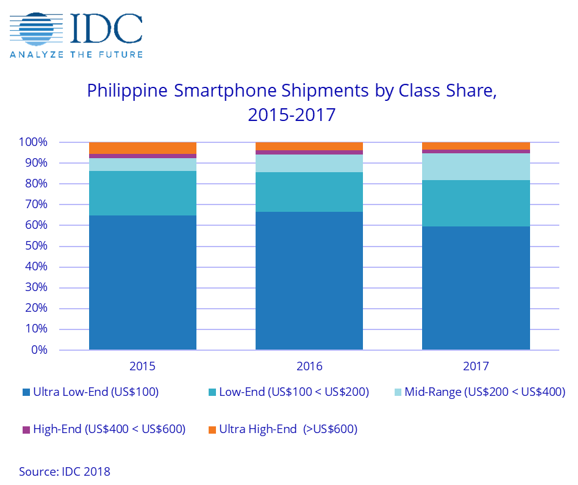
A clear trend has recently emerged in the Philippine smartphone market where end users are shifting to handsets with higher specs and better features. The Philippines has historically been among the price-sensitive markets in Asia/Pacific and still is. Despite this, the average selling price of smartphones in 2017 grew to US$134, a 13% YoY increase. Ultra low-end smartphones (<US$100) still hold the lion's share of the market, accounting for 59% of all smartphones in 2017 compared with 67% in 2016. Meanwhile the combined share of low-end (US$100<US$200) and midrange (US$200<US$400) smartphones grew to 35% from 28% in 2016.

Samsung and Chinese brands such as OPPO and Vivo were the key driving brands that led to the growth of the low-end and midrange segments in 2017. "Heavy marketing campaigns and lucrative sales promoter incentives enabled these brands to strengthen their mindshare in the local market, increase their shipments, and grow their respective market shares. The assault of these brands affected the sales of some of the players, resulting in them reducing their supplies, which ultimately impacted overall smartphone shipments," said Jensen Ooi, Senior Market Analyst, Client Devices, IDC ASEAN.
From a screen size perspective, phablets (5.5”<7”) recorded significant growth in recent years, accounting for about a quarter of smartphone shipments in 2017. "As mobile content continues to grow, smartphones have become the primary device for basic productivity and everyday media consumption, and this fuels the need for larger screens and higher specs," Ooi added. On the other hand, slate tablets (7”<11”), which used to be popular at one point, have begun to suffer from decreasing sales because they cannot offer the same level of practicality that phablets provide.
Aside from slate tablets, detachable tablets have also not caught on well in the Philippine market. Filipino end users find the relatively low specs but high price of detachables unappealing and opt for laptops within the same price range, which provide better overall utility.

PCs – Thriving in a Smartphone-Driven Country
The Philippines is among the few remaining bright spots for traditional PCs in Asia/Pacific. Looking closer, it is the only one in Southeast Asia that still shows PC adoption growth. Over the past five years, the Philippine PC market has been growing at a compound annual growth rate (CAGR) of 3%, while its ASEAN neighbors have been declining at CAGRs of around -3% to -12%. The Philippines’ growth trend has been driven primarily by the country's slow technology adoption, but in the past few years, the mobility trend and large millennial Filipino population are also propelling traditional PC adoption to even higher levels.
"Despite smartphones having drawn away a portion of consumer demand in recent years, desktop and notebook PCs remain viable personal computing devices, especially for heavy workloads and higher-level entertainment," said Sean Paul Agapito, Associate Market Analyst, Client Devices, IDC Philippines. While the growing on-the-go culture has fueled the PC-versus-smartphone trend among Filipino consumers, it has also influenced form factor trends within the PC domain. Laptops have already overtaken desktops as the traditional PC of choice among consumers, with the latter increasingly being relegated to commercial and gaming uses.


What to expect in 2018?
The smartphone market in the Philippines is expected to rebound in 2018 as competition between popular brands, which will continue to strengthen their positions, and local and minor brands, which will continue to struggle to stay relevant, intensifies. "We expect smartphone vendors to continue shipping in more phablets and equipping their new models with enticing features, such as dual cameras, thin bezels, and on-device artificial intelligence,” Ooi said.
Meanwhile, the Philippine PC market is expected to grow in the coming years to be driven by the hype and popularity of PC gaming and esports, growing momentum of telecommuting, and shift toward digital learning/education. "As the Philippine economy matures, Internet services and coverage improve, and more Filipinos realize the potential of the Internet beyond social interaction – such as for education, work, and business among others – demand for PCs in the country is expected to grow even further," Agapito said.
For more information about the research, please contact Jensen Ooi at jooi@idc.comand Sean Paul Agapito at sagapito@idc.com.  For media inquiries, please contact Jubert Alberto at jalberto@idc.com or Rushanthine at rvelayutham@idc.com
-Ends-
 
About IDC Trackers
IDC Tracker products provide accurate and timely market size, vendor share, and forecasts for hundreds of technology markets from more than 100 countries around the globe. Using proprietary tools and research processes, IDC's Trackers are updated on a semiannual, quarterly, and monthly basis. Tracker results are delivered to clients in user-friendly excel deliverables and on-line query tools. The IDC Tracker Charts app allows users to view data charts from the most recent IDC Tracker products on their iPhone and iPad.

About IDC
International Data Corporation (IDC) is the premier global provider of market intelligence, advisory services, and events for the information technology, telecommunications, and consumer technology markets. With more than 1,100 analysts worldwide, IDC offers global, regional, and local expertise on technology and industry opportunities and trends in over 110 countries. IDC's analysis and insight helps IT professionals, business executives, and the investment community to make fact-based technology decisions and to achieve their key business objectives. Founded in 1964, IDC is a subsidiary of IDG, the world's leading technology media, research, and events company. To learn more about IDC, please visit www.idc.com. Follow IDC on Twitter at @IDC.
All product and company names may be trademarks or registered trademarks of their respective holders.

Friday, February 9, 2018

eBlast : Reliving your greatest gaming moments just got more seamless with the new Radeon ReLive video toolkit


Following the release of the new Radeon Software Adrenalin Edition last month, designed to give gamers deeply immersive gameplay and inspired by today’s era of social, connected gaming, AMD has just released a new video toolkit to help fans get the most from the supercharged Radeon ReLive and its suite of new features.
With eSports expanding into a $1.5 billion industry this past year and revenue expected to grow 26 per cent by 2020, the stakes are higher than ever for fans to grow their following and step up their streaming game.

AMD’s new series of short how-to videos help gamers better use Radeon ReLive for creating, capturing and sharing their greatest gaming moments, so they can show off their skills and expand their communities.
To get the most out of these powerful new features, you can check out each Radeon ReLive how-to video here:
Test Radeon ReLive for yourself by downloading Adrenalin Edition 18.1.1 here.
You can view more videos on Radeon ReLive here:
Stay tuned for more how-to content to come from Radeon Software!

Thursday, January 18, 2018

AMD and Cyzone Combine to Equip Vietnam’s Largest I-Cafes with the latest Ryzen CPUs


AMD has announced that it will be supplying Cyzone’s newest I-cafe in Vietnam with Ryzen CPUs, giving Cyzone best price/performance and long term platform stability, and further strengthening Cyzone’s position as one of the leaders in the Vietnam I-Café market.

Cyzone has a long history in the PC market in Vietnam with the company being set up in 2004. They have 2 i-cafes with over 800 PCs currently, including the Dang Van Ngu branch and the brand new Vo Thi Sau branch which is being equipped with AMD’s latest Ryzen 3 and Ryzen 5 CPUs that were launched to great success in 2017. Cyzone are actively involved in the gaming community and were recently crowned Vietnam champions at the Overwatch SEA Tournament and went on to represent their country at the group stage of the World Cup 2017 Overwatch tournament in Sydney, Australia.

AMD Ryzen CPUs were launched in 2017 and saw the return of AMD to the high performance CPU space. The revolutionary Zen architecture, developed over 4 years saw huge uplifts in performance of the AMD CPU core and large gains in efficiency. With the highly competitive AM4 platform offering stability and CPU upgradability until 2020, the Ryzen family of CPUs offer an ideal solution for I-cafes, system builders and those looking to build their own PCs. AMD’s Channel Sales Director for ASEAN, Mr Ryan Sim commented that “collaborating with partners is central to AMD and we are delighted to be working with Cyzone on this project to bring high performance computing to as many as possible”. He also expressed that there were ongoing plans to continue the resurgence of AMD and “improve the adoption of AMD Ryzen CPUs throughout the region”, with a range of partners in the PC industry.

The owner of Cyzone, Vu Thanh Cong, has a passion for IT hardware and has been a long time user of AMD processor, noting that “AMD always inspired us – the real IT component hardware enthusiasts”. Vu Thanh Cong considered many factors when choosing the platform to use in their brand new Vo Thi Sau branch with over 500 systems installed. However, after looking at the available options he concluded that “Ryzen is a very suitable choice meeting not only price/performance requirements, but also investment cost criteria”, with the advantage of platform stability giving the reassurance that “For the long term, there is upgrade possibilities at a competitive cost”.

Aside from the product performance and suitability for his I-café’s, Vu Thanh Cong was excited to see how the “Ryzen launch provided users reasonable choices and made the PC market excited again with renewed competition helping to accelerate performance/price/innovations. It brings a lot of benefits to the end user”.

AMD continues to support the gaming market in ASEAN and with Ryzen and Radeon products offering excellent solutions for many customers it expects that this growth will continue as more products are brought to market in 2018 and beyond.

*This is Press Release

Monday, January 8, 2018

AMD Redefines High-Performance Computing with New Processor and Graphics Products Preview at CES 2018


Building on the global enthusiasm generated in 2017 by Ryzen™ processors and Radeon™ graphics technology, AMD (NASDAQ: AMD) today detailed its forthcoming roll-out plan for its new and next generation of high-performance computing and graphics products during an event in Las Vegas just prior to the opening of CES 2018. Alongside announcing the first desktop Ryzen™ processors with built-in Radeon™ Vega Graphics, AMD also detailed the full line up of Ryzen™ mobile APUs including the new Ryzen™ PRO and Ryzen™ 3 models, and provided a first look at the performance of its upcoming 12nm 2nd generation Ryzen™ desktop CPU expected to launch in April. In graphics, AMD announced the expansion of the “Vega” family with Radeon Vega Mobile and that its first 7nm product is planned to be a Radeon “Vega” GPU specifically built for machine learning applications.
“We successfully accomplished the ambitious goals we set for ourselves in 2017, reestablishing AMD as a high-performance computing leader with the introduction and ramp of 10 different product families,” said AMD President and CEO Dr. Lisa Su. “We are building on this momentum in 2018 as we make our strongest product portfolio of the last decade even stronger with new CPUs and GPUs that bring more features and more performance to a broad set of markets.”  
Technology Updates
AMD CTO and SVP Mark Papermaster shared updates on AMD’s process technology roadmaps for both x86 processors and graphics architectures.
·         x86 Processors
o   The “Zen” core, currently shipping in Ryzen desktop and mobile processors, is in production at both 14nm and 12nm, with 12nm samples now shipping.
o   The “Zen 2” design is complete and will improve on the award-winning “Zen” design in multiple dimensions.  
·         Graphics Processors
o   Expanding the “Vega” product family in 2018 with the Radeon Vega Mobile GPU for ultrathin notebooks.
o   The first 7nm AMD product, a “Vega” based GPU built specifically for machine learning applications. 
Client Compute Updates
AMD SVP and General Manager, Computing and Graphics Business Group Jim Anderson detailed upcoming AMD client compute processors including:
·         The Ryzen™ desktop processor with Radeon™ graphics
o   Desktop Ryzen™ APUs combine the latest “Zen” core and AMD Radeon™ graphics engine based on the advanced “Vega” architecture, bringing:
§  The highest performance graphics engine in a desktop processor[i]
§  Advanced quad core performance with up to 8 processing threads
§  1080p HD+ gaming performance without a discrete graphics card
§  Beautiful display features with Radeon™ FreeSync technology[ii]
§  Full benefit of Radeon™ software driver features including Radeon™ Chill, Enhanced Sync and Radeon™ ReLive
o   Planned to be available starting February 12, 2018.

Ryzen™ Desktop Processors with Radeon™ Vega Graphics:

Model
CPU Cores
Threads
Max Boost Clock (GHz)
Graphics Compute Units[iii]
Max GPU Clock (MHz)
L2/L3 Cache (MB)
cTDP (Watts)
Ryzen™ 5 2400G
with Radeon™ RX Vega11Graphics
4
8
3.9
11
1250
6
45-65W
Ryzen™ 3 2200G
with Radeon™ Vega8Graphics
4
4
3.7
8
1100
6
45-65W

·         2nd generation Ryzen™ desktop CPU
o   AMD’s first 12nm based processor with Precision Boost 2 technology.
o   Scheduled for introduction April 2018.

·         Ryzen™ PRO Mobile Processors with Radeon™ Vega Graphics
o   Targeted for commercial, enterprise, and public sector implementation, Ryzen PRO mobile processors are designed to power sleek and powerful enterprise notebooks featuring the world’s fastest processor for commercial ultrathin notebooks[iv], state-of-the-art silicon-level security, and reliable solutions with enterprise-class support and product stack top-to-bottom DASH manageability.
§  Up to 22% more competitive productivity performance[v]
§  Up to 125% more competitive graphics performance than Intel i7-8550U and 150% more competitive graphics performance than Intel i7-7500U[vi]
§  Targeting Up to 13.5 hours of battery life[vii]
§  SenseMI[viii] features including Precision Boost 2 technology and Mobile Extended Frequency Range (mXFR)[ix]
o   Ryzen™ PRO mobile solutions are expected to launch in Q2 2018.

Ryzen™ PRO mobile processors with Radeon™ Vega Graphics:

Model
CPU Cores
Threads
Max Clock (GHz)
Graphics Compute Unitsiii
Max GPU Clock (MHz)
L2/L3 Cache (MB)
cTDP (Watts)
Ryzen™ 7 PRO 2700U with Radeon™ Vega10 Graphics
4
8
3.8
10
1300
6
15W Nominal
Ryzen™ 5 PRO 2500U with Radeon™ VegaGraphics
4
8
3.6
8
1100
6
15W Nominal
Ryzen™ 3 PRO 2300U with Radeon™ VegaGraphics
4
4
3.4
6
1100
6
15W Nominal

·         Ryzen™ Mobile Processor with Radeon™ Vega Graphics
o   AMD expanded the Ryzen Mobile Processor family, featuring the world’s fastest processor for ultrathin notebooks line up, with the introduction of the Ryzen 3 mobile processor.

Ryzen™ mobile processors with Radeon™ Vega Graphics:

Model
CPU Cores
Threads
Max Clock (GHz)
Graphics Compute Unitsiii
Max GPU Clock (MHz)
L2/L3 Cache (MB)
cTDP (Watts)
Ryzen™ 7 2700U with Radeon™ Vega10 Graphics
4
8
3.8
10
1300
6
15W Nominal
Ryzen™ 5 2500U with Radeon™ Vega8 Graphics
4
8
3.6
8
1100
6
15W Nominal
Ryzen™ 3 2300U with Radeon™ Vega6 Graphics
4
4
3.4
6
1100
6
15W Nominal
Ryzen™ 3 2200U with Radeon™ Vega3 Graphics
2
4
3.4
3
1000
5
15W Nominal

Graphics & Gaming Updates

AMD discussed its first mobile discrete graphics solution based on the “Vega” architecture. This razor-thin Radeon Vega Mobile GPU is designed to enable new, powerful gaming notebooks in 2018 with extraordinary performance and incredible efficiency.

AMD also announced that Radeon™ Software will add support for HDMI 2.1 Variable Refresh Rate (VRR) technology on Radeon™ RX products in an upcoming driver release. This support will come as an addition to the Radeon™ FreeSync technology umbrella, as displays with HDMI 2.1 VRR support reach market.

Ubisoft announced that Far Cry 5 will support Radeon™ RX Vega specific features like Rapid Packed Math as well as Radeon™ FreeSync 2 technology. Radeon™ RX Vega owners will be able to enjoy Far Cry 5 at exceptional fidelity, with stunning frame rates and beautiful image quality.


About AMD
For more than 45 years, AMD has driven innovation in high-performance computing, graphics, and visualization technologies ― the building blocks for gaming, immersive platforms, and the datacenter. Hundreds of millions of consumers, leading Fortune 500 businesses, and cutting-edge scientific research facilities around the world rely on AMD technology daily to improve how they live, work, and play. AMD employees around the world are focused on building great products that push the boundaries of what is possible. For more information about how AMD is enabling today and inspiring tomorr
AMD, the AMD logo, Ryzen, Radeon, Threadripper, and combinations thereof, are trademarks of Advanced Micro Devices, Inc.

*This is Press Release